Indian Rockets
Overview
 ISRO Rockets
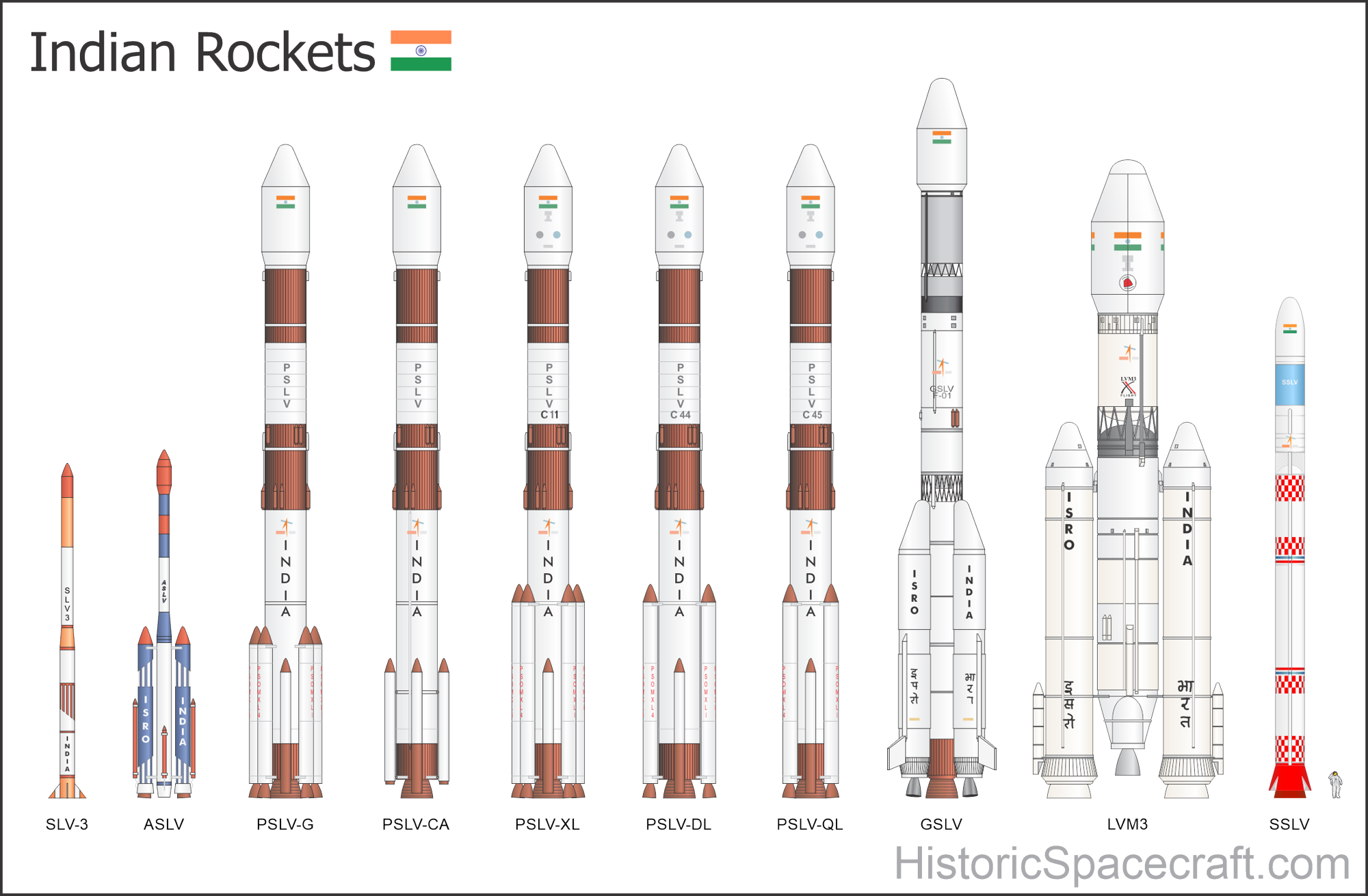
An illustration showing several rockets developed and operated by the Indian Space Research Organization (ISRO).
(
View Larger Version)
The Indian Space Research Organization, or ISRO, is the Indian governmental agency responsible for spaceflight.
ISRO currently operates several space launch systems and is competitive in the international satellite launch market.
ISRO also oversees several satellite programs, including the Indian National Satellites (INSAT) communication satellites,
and Indian Remote Sensing (IRS) satellites for Earth resource monitoring.
ISRO has developed and flown several successful space probes, including the Mars Orbiter Mission
and the Chandrayaan-1 Lunar Orbiter Mission.
An attempted Lunar landing mission in 2019 failed.
India plans to move forward with several ambitious space development goals, including larger rockets and a human spaceflight capability.
SLV-3 (Satellite Launch Vehicle)

SLV (Satellite Launch Vehicle)
SLV (Satellite Launch Vehicle) was a four-stage, all solid fueled, expendable launch vehicle.
An SLV-3 rocket, launched on 18 July 1980, placed the Rohini (RS-1) satellite into orbit.
ASLV (Augmented Satellite Launch Vehicle)

ASLV
The ASLV (Augmented Satellite Launch Vehicle) was a five-stage, all solid fueled, expendable launch vehicle.
Test flights began in July, 1988. The third ASLV, launched on 20 May 1992, placed the SROSS-C satellite into orbit. ASLV-D4, the fourth and final ASLV to fly, placed the SROSS-C2 satellite into orbit on 4 May 1994.
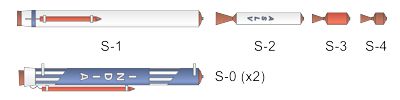 ASLV Stages
PSLV (Polar Satellite Launch Vehicle)
The PSLV (Polar Satellite Launch Vehicle) is an expendable launch vehicle operated by ISRO (Indian Space Research Organization).
PSLV has four stages.
The first and third stages use solid propellants, while the second and fourth stages are liquid fueled.
PSLV launchers include up to six strap-on boosters.
The PSLV rocket family has proved highly reliable and is still in service.

PSLV-G
The standard PSLV configuration includes 6 strap-on boosters.
The first PSLV development flight, occurring on 20 September 1993, was unsuccessful.
The second PSLV flight, on 15 October 1994, was successful.

PSLV-CA
PSLV-CA is the "Core Alone" version without any strap-on boosters.
The first PSLV-CA launch occurred on 23 April 2007.

PSLV-XL
PSLV-XL includes six improved strap-on boosters.
A PSLV-XL rocket launched the Chandrayaan-1 lunar orbiter spacecraft on 22 October 2008.

PSLV-DL
The PSLV-DL variant uses two strap-on boosters and was first flown in 2019.

PSLV-QL
The PSLV-QL variant uses four strap-on boosters and was first flown in 2019.
GSLV (Geosynchronous Satellite Launch Vehicle)

GSLV
The GSLV (Geosynchronous Satellite Launch Vehicle) is an expendable launch vehicle designed to put 2,000 - 2,500 kg payloads into Geosynchronous Transfer Orbit (GTO). Developed from the successful PSLV, the GSLV adds liquid fueled strap-on boosters and a cryogenic upper stage.
The first GSLV rocket launched the GSAT-1 satellite into orbit on 18 April 2001. Unfortunately, the satellite was placed in a lower than planned orbit.
The rocket has experienced several failures in the first seven launches.
LVM3
The LVM3, currently under development by ISRO, will be capable of placing heavy payloads into geo-synchronous orbit. The rocket is designed to include a cryogenic upper stage.

LVM3-X/CARE
LVM3-X/CARE was launched on December 18, 2014. The mission tested the first stage and boosters for the LVM3 rocket. The mission did not include an active upper stage and flew a suborbital trajectory.
The mission included an experimental space capsule known as CARE (Crew module Atmospheric Reentry Experiment). The capsule successfully completed it's mission and was recovered in the Indian Ocean.
SSLV (Small Satellite Launch Vehicle)

The Small Satellite Launch Vehicle (SSLV) is a low-cost launcher designed to place one or more small payloads into orbit.
The first three stages are solid-fueled. A fourth stage, known as the Velocity-Trimming Module (VTM),
provides attitude control and final orbit insertion for the payload.
The first SSLV mission, flown in 2022, failed to place the payload into orbit. The second flight, in 2023, was successful.
References
Indian Space Research Organization
 Images by Richard Kruse are licensed under a Creative Commons Attribution-Noncommercial 3.0 United States License.